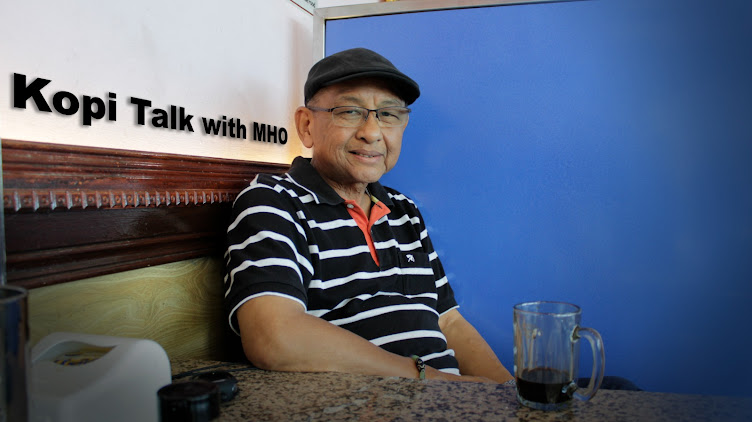
By Malai Hassan Othman | KopiTalk, Borneo Bulletin | First published: early 2000s
Editor’s note: This piece was written to mark Brunei’s National Day anniversary, when the theme that year focused on national identity and the need to strengthen it. It appeared in KopiTalk in the Borneo Bulletin. References to specific internet technologies have been lightly updated; the argument is reproduced as written. — MHO, July 2026
We in Brunei marked our National Day anniversary that year with a theme focusing on national identity and the need to strengthen it. It was fitting indeed, coming at the start of a new millennium — an era supposed to bring along a glut of great challenges and opportunities.
In this new era, the so-called globalisation process — driven by the rapid evolution of information technology — is slowly stripping down geographical boundaries and merging different nations into a borderless global village. Technology is revolutionising the way we do business, the way we trade, invest and interact with each other.
But with this rush of the IT era sweeping the world, we are also witnessing a revolutionary change in our way of thinking, our mindset, for better or for worse. Never mind all the good things that can happen to us as a result of this rapid IT development and the globalisation process. What clearly worries us, and our leaders, are the adverse effects these developments can have on our society.
We are not just talking about what damages IT and globalisation can do to our business sector. These can be actually addressed effectively by making some financial adjustments. But what worries our nation is the adverse influence of technology on our society. IT development is not only transcending geographical boundaries — it can also strip down the social fabric, erode cultural and religious values of a community.
This is already happening in many developed and developing countries. Brunei is at the crossroads, and the path we are taking leads us towards the mainstream of the globalisation process. So for us in Brunei, as we continue with our march into the new millennium, we must not allow ourselves to stray from our spiritual, cultural and social values and our national identity.
However, to uphold and strengthen our national identity as Bruneians, we also need to understand what it means to be a Bruneian.
But unfortunately, in today’s modern environment, the younger generation in particular tends to mistakenly identify itself with other alien cultures and values. Even some families have misplaced their family pride. Misplaced in a sense that they were overzealously proud of their adoption of alien values dictated by this materialistic world.
As one of my friends in Parliament observed at the time, Bruneians, it seems, have lost their real identity as Bruneian Malays. He said we were living in an era where life begins with ‘e’ — e-commerce, e-style, e-prayer — and we were slowly witnessing the erosion of self-esteem and identity among our younger generations.
“Susah… susah… udang sudah jadi belacan!” he lamented — referring to how some people have lost their self-esteem and identity in this headlong rush of the IT age. He said an udang — a prawn — will always be a prawn, no matter what one does to it, except when it is pounded and reduced to belacan — paste.
“We can fry it, and yet it will be called a fried prawn. We can make curry out of it, and yet it will be called a prawn curry. So you see my point — the identity of the prawn is only lost when we make a ‘belacan’ of it,” he added. Although everyone laughed at the analogy, his message hit home. Everyone agreed that it is indeed important to do something now to ensure that the Bruneians don’t become ‘belacan’ like the ‘udang’.
The other day I became witness — or to be more precise, an ‘e-witness’ — to our young people or to our community e-chatting over in a virtual chat room on our social media platforms. They were chatting satirically about what it means to be a Bruneian. Their definition, or rather their perception of what it means to be a Bruneian, was provocatively revealing in a sense that their positive views on what it takes to be a Bruneian leave much to be desired.
If their aim is to make sure Bruneians erased all the negative traits that distinguish us from other nationalities, then they deserve all the plaudits. At first I found their list of what defined a true-blooded Bruneian rather ludicrous. But on second thought, I believed we should make use of it as a reflection on ourselves and try to mend our ways.
Here are some of the characteristics of a true Bruneian I found in that virtual chat room:
• You think other Asian countries are poorer than yours
• Your local McDonald’s serves rice and sambal
• You have tried passing Malaysian coins in a vending machine or pay phones
• You have smuggled electronics, CDs and other items into Brunei
• You do your shopping in Singapore, United Kingdom and Miri
• You realised that money is everything before you were six
• You think the Liga Perdana is equal to a Super Bowl
• You talk loud thinking everyone is deaf, but actually YOU are
• Your clothing has brand names printed on it that are visible from 50 feet away
• You have paid more than BND100 to get your own private car license plate
• Sago (ambuyat) is your staple food and it is a necessity to have loads of it even when staying overseas
• You act like a rich tycoon in Miri even if your average income is below BND1,000
• You furnish your home luxuriously even if it means eating rice and kicap for the last two weeks before the end of the month
• Hutang — debt — is your best friend
• You make sure that everything you consume at home is halal but eat everything else when you are overseas
If the way young Bruneians identify their countrymen is anything to go by, we can expect the future that our generation is building to end up in a worse state than belacan.
It is not too late. But it is time — well past time — to ask ourselves honestly what kind of Bruneians we are raising, and what kind of Brunei we are building for them to inherit.
These two columns were first published in KopiTalk in the Borneo Bulletin in the early 2000s. They are reproduced here on Substack as part of an ongoing archive series. A new KopiTalk essay engaging with these themes in the context of His Majesty’s Ilal Hijrah 1448 address — ‘Hijrah Penyelamat Aqidah: Faith in the Age of the Algorithm’ — is available in the current issue. — MHO
Malai Hassan Othman is a veteran journalist, political analyst, and Executive Director of Barakah Bioindustries Company. KopiTalk with MHO is published on Substack at kopitalk.substack.com

.jpeg)
No comments:
Post a Comment