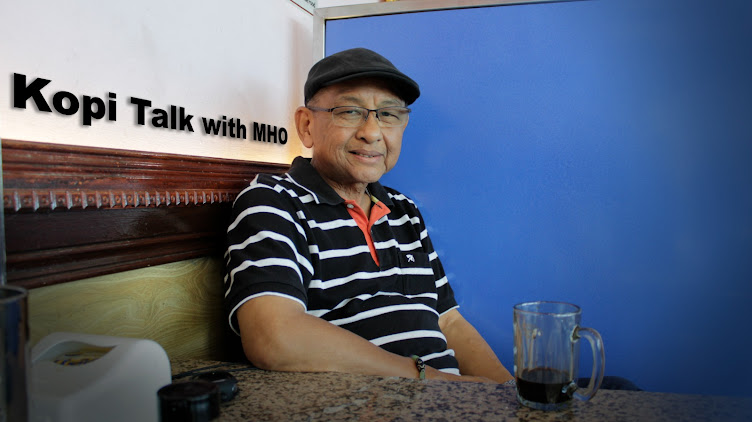
For six decades, Brunei has studied its economic challenges, commissioned reports and refined strategies. Perhaps the greatest obstacle was never a lack of ideas, but a habit of delaying action. At what point does another diagnosis become an excuse? And when do we finally begin the treatment? #KopiTalk

Part 4: The Habit We Must Break
The problem was never the diagnosis. It was always the treatment.
By Malai Hassan Othman
I remember the confidence.
Not the buildings. Not the contracts. Not the ceremonies.
The confidence.
In the years after independence, there was a quality in the air difficult to describe to anyone who did not feel it. A sense that Brunei was finally the author of its own story. That the men and women of this nation — our architects, our engineers, our entrepreneurs — would build what independence had promised. Not just politically. Economically. On our own soil, with our own hands, for our own people.
We were jealous of that aspiration.
Jealous in the right sense. Protective. Fierce about it. Unwilling to let it go.
The pioneers proved it was possible. Arkitek Ibrahim. Arkitek Idris. The engineers and quantity surveyors who walked away from secure government careers because they believed a newly independent nation needed more than capable administrators.
It needed captains of industry.
And for a while, we were building them.
DMAO spent decades watching what happened next.
A former Permanent Secretary who served across the Ministry of Industry and Primary Resources, the Ministry of Development and the Ministry of Communications — and later as Director of the Civil Service Institute — he observed the system from the inside across the very decades this series has been examining. He watched the plans arrive. He watched the recommendations accumulate. He watched the institutions respond.
And recently, in a paper written this year, he gave the pattern its name.
Dengar cerita… tunggu data.
Four words of Malay that say what sixty years of English-language policy documents could not quite land.
We hear the story. We feel the concern. We register the problem.
And then we wait for more data.
Not from bad faith. Not from indifference. But from a habit so deeply embedded in our institutional culture that it feels like prudence — like due diligence — when it is actually avoidance dressed in the language of process.
Dengar cerita… tunggu data.
That phrase will stay with this series because it names, with painful precision, the habit that may have cost us most.
The scale of that cost is measurable.
Economic diversification has been a stated goal of national policy since the Second National Development Plan of 1962 to 1966.
Not 1984. Not Wawasan 2035.
1962.
In 1995, the Manchester Business School produced recommendations. In 1997, the Ministry of Industry and Primary Resources produced its own. In 1999, the Brunei Darussalam Economic Council warned of fundamental problems threatening prosperity and stability. In 2001, the National Development Committee added its voice. In 2003, the Monitor Group was commissioned to examine the same ground again.
Five major studies in eight years.
All well-formulated. All with specific, actionable recommendations. All broadly pointing in the same direction.
In 2004, Haji Razali bin Haji Johari stood before the National Day Majlis Ilmu and called for an Anjakan Paradigma.
In 2007, Manu Bhaskaran of the Centennial Group was commissioned by CSPS to examine why, despite much effort and competent governance, diversification had not succeeded. His finding was precise and uncomfortable.
The problem was not the plans.
The plans were good.
The problem was the enabling environment. The habits. The incentives. The institutional conditions that determined whether good plans became lasting change.
In 2016, the DPPMB 3rd World Café found that only 3 per cent of development project allocations reached genuine local companies, when 40 per cent was the threshold needed for meaningful local business development.
That recommendation is still waiting.
And in 2026, DMAO — who watched much of this from inside the machinery — documented the recurring habits of national execution failure.
Dengar cerita… tunggu data.
The diagnosis has never been the problem.
We are — and have always been — extraordinarily good at diagnoses.
What we have struggled with is treatment.
And Mu’aqabah — genuine self-correction, not regret, not another consultation, not another plan — begins with naming honestly what has resisted treatment for so long.
So let us name it.
The first habit is analysis paralysis.
The system already knows the problems.
Youth unemployment. SME fragility. The procurement gap between what local companies receive and what they need to build genuine enterprise. The commercial space occupied by others because local capacity did not grow fast enough to fill it.
These are not new discoveries. They have been documented, discussed and acknowledged across six decades of national development planning.
Yet the institutional reflex remains familiar: study further, refine the finding, validate again, commission another review before beginning treatment.
There is a difference between caution and avoidance.
Caution is appropriate when the facts are unclear.
When the facts have been established repeatedly across decades, caution becomes something else.
It becomes a habit.
Dengar cerita… tunggu data.
The second habit is the institutional illusion.
A system can run programmes, spend budgets, produce reports — and still fail to change outcomes.
We have agencies. Enterprise development frameworks. Training programmes. Funding schemes. Procurement policies. Strategic plans. We have, by any institutional measure, the architecture of a nation serious about economic development.
And yet the commercial landscape remains substantially familiar.
Ali Baba. Ali Chandran. Ali Bangla.
The same patterns that troubled us twenty years ago trouble us today. The same questions Lord Joe raised in 2004 are being raised again in 2026.
The institutional illusion is the belief that activity is the same as change. That a programme launched is a problem addressed. That a budget spent is an outcome achieved.
It is not.
When we measure success by workshops conducted rather than enterprises that survived, we are measuring the wrong thing. When we report the number of youths trained rather than the number employed and earning a sustainable income, we are confusing motion with progress.
Mu’aqabah does not accept it.
It asks one question only:
What actually changed?
The third habit is compliance without amanah.
In a system that rewards procedure and penalises risk, the rational individual choice is to follow the process, complete the task, submit the report — and leave the outcome to someone else.
Not my scope.
No instruction yet.
This is not always a moral failure. Often, it is a rational response to a system that has not made outcome accountability the condition of professional standing.
But collectively, it is devastating.
When no one owns the outcome — when responsibility is distributed across committees, agencies and leadership transitions — good ideas die quietly. Not because anyone decided to kill them. Because no one was accountable for keeping them alive.
The World Café documented this with uncomfortable clarity. Initiatives stalled not because the ideas lacked merit but because continuity was lost. A new leader arrived. Priorities shifted. Institutional memory faded. The programme that was gaining traction quietly disappeared.
Knowledge without action changes very little.
But action without continuity is little better.
Amanah — genuine, trust-driven accountability for outcomes rather than mere compliance with procedure — is what the system has been missing.
It is not only a management concept.
It is a moral one.
The 5M framework reminds us of this:
Mu’ahadah as covenant,
Mujahadah as striving,
Muraqabah as awareness,
Muhasabah as self-reckoning, and
Mu’aqabah as self-correction.
Mu’aqabah demands more than recognising what went wrong.
It demands correction.
These are not system errors.
They are system habits.
Errors can be corrected by fixing a process.
Habits require something harder — sustained cultural change that persists across leadership transitions, budget cycles and the institutional pressure to return to the comfortable rhythm of diagnoses and delay.
That is what makes Mu’aqabah at the national level so difficult.
And so necessary.
Because the numbers are no longer abstract.
Oil revenue in 2025 stood at BND 2.36 billion — and falling. The fiscal deficit reached BND 3.09 billion. The cushion that made urgency invisible for four decades is thinning in real time.
For a generation, oil wealth funded our civil service, subsidised our living costs and made economic urgency feel optional. Enterprise seemed unnecessary when security was available without it. Risk seemed irrational when comfort was guaranteed without it.
Bhaskaran identified this in 2007: the prevalence of government employment and subsidies creates incentives that do not propel workers to strive, compete and build.
He was not criticising Bruneians.
He was describing the rational response of an intelligent people to the incentive structure that oil wealth created.
But that incentive structure is changing.
The urgency that was invisible in 1990 is now visible whether we choose to see it or not.
This is not yet a crisis.
It is an opportunity.
The moment when Mu’aqabah shifts from morally right to economically necessary.
So what does genuine self-correction look like?
Not a new plan. The plans are not the problem.
Not a new agency. The agencies exist.
Not another consultation. The consultations have been thorough, the recommendations specific, the findings consistent across six decades.
Genuine self-correction means three things.
First, measure outcomes, not outputs.
Every enterprise development programme must be evaluated not by the number of participants but by the number of sustainable businesses it produced. Not by workshops conducted but by income generated. Not by budget spent but by economic sovereignty advanced.
If a procurement policy is designed to deliver 40 per cent of project value to local companies and delivers 3 per cent, that is not partial success.
It is measurable failure.
And it must be named clearly.
Second, build institutions that outlast the people who run them.
Every initiative must have a handover protocol. Every programme must have documented commitments that survive leadership transitions. Every accepted recommendation must have a named owner — not a committee, not a shared responsibility — one person whose accountability is tied to the outcome.
The ecosystem the pioneer generation began — financing, mentorship, procurement discipline, cooperative structures, patient capital — was never completed not because it was impossible, but because institutional continuity was never built around it.
Continuity is not an administrative detail.
It is the difference between a plan and a transformation.
Third, change the signal sent to the next generation.
Every family that steers a capable child toward government employment rather than enterprise is making a choice. Every school that produces administrators rather than builders is making a choice. Every institution that honours the graduate who joins the civil service but not the one who risks everything to build a business is making a choice.
Mu’aqabah asks for a different choice.
Not because government employment is wrong.
But because a nation that channels all its talent into administration and too little into enterprise will always find that the commercial life of its towns belongs to someone else.
The signal sent to the next generation may be the most important reform available.
It costs nothing to change.
And everything follows from it.
The pioneers of the 1980s did not wait for the enabling environment to be perfect.
They stepped forward and helped build it themselves.
They understood something that six decades of studies, consultations and strategic plans have documented but not yet delivered at scale — that economic sovereignty is not merely a policy outcome.
It is a cultural achievement.
Built enterprise by enterprise, family by family, generation by generation, by people who have decided that the economy of their nation belongs to them in practice, not only in principle.
Mu’aqabah does not ask whether we understand this.
The record — from 1962 to 2026 — shows that we do.
It asks whether we are finally prepared to act on it.
Not another study.
Not another plan.
Not another consultation whose recommendations wait nine more years beside the ones that came before.
For sixty years, Brunei has studied the road ahead.
We have commissioned reports.
We have gathered experts.
We have written strategies.
We have diagnosed the illness with remarkable consistency.
Mu’aqabah asks only one question.
When do we finally begin the treatment?
KopiTalk with MHO • The Unfinished Agenda • Part 4 of 5
Read here for:
Part 1: Twenty-Two Years Later
Part 3: The Mirror We Must Face

.jpeg)
No comments:
Post a Comment