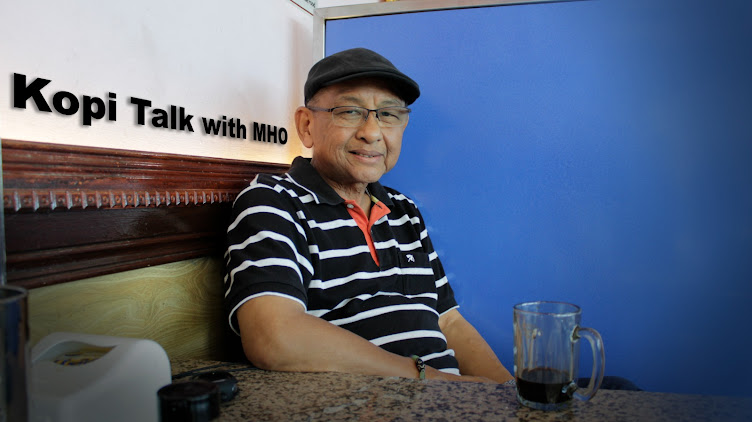
Twenty-two years ago, Brunei recognised that political independence was only the beginning. The harder journey was building economic strength through discipline, institutions and a change in mindset. Today, as Wawasan Brunei 2035 draws nearer, perhaps the real question is not what we planned—but whether we truly walked the path we chose. #KopiTalk

The hardest transformation is not changing policies. It is changing the way we think.
By Malai Hassan Othman
There is a difference between recognising a problem and allowing that recognition to transform us.
The first requires awareness.
The second requires courage.
Twenty-two years ago, Haji Razali bin Haji Johari—better known to many in Brunei’s business community as Lord Joe—stood before Brunei’s National Day Majlis Ilmu and called for what he described as an Anjakan Paradigma—a paradigm shift. It was not a passing remark buried in an academic paper. It was one of the central ideas presented at a gathering held to mark two decades of Brunei’s independence, as the nation reflected not only on what it had achieved but also on what it still hoped to become.
And Brunei had achieved something real.
Twenty years of independence. Political sovereignty restored. A nation governed by its own people, under its own flag, guided by its own faith and values. That is no small achievement. By any regional measure, it was a remarkable milestone—one that deserves to be acknowledged before anything else is said.
But Lord Joe was not speaking about what had been achieved.
He was speaking about what had not.
Because political sovereignty, however hard-won, is only the first half of independence.
The second half—economic sovereignty—is a different matter entirely.
And it was that second half that Lord Joe was asking us to think about differently.
Walk through the commercial heart of any Bruneian town today.
Look at who runs the shops.
Look at who holds the contracts—and who does the actual work behind them.
Look at who builds wealth quietly, year after year, within an economy whose sovereignty is undeniably our own.
Then ask yourself an honest question.
Does this economy reflect the aspirations of independence we celebrated two decades ago?
That unease has a name.
It is not jealousy.
It is not resentment looking for a target.
It is something more fundamental—the quiet but persistent feeling that political sovereignty and economic dignity are not yet the same thing.
That we have won the right to govern ourselves without yet fully winning the right to shape our own economic destiny.
That is the feeling Anjakan Paradigma was meant to address.
Not through blame.
Not through protectionism dressed up as policy.
But through a genuine shift in how we think about enterprise, discipline, ownership and responsibility.
“Paradigm shift” has since become part of our everyday vocabulary.
We invoke it in speeches.
We repeat it in seminars.
We insert it into strategic plans and conference themes.
Yet phrases have a habit of becoming comfortable.
The more often they are repeated, the less they disturb us.
Perhaps that is the first lesson hidden inside Lord Joe’s paper.
Anjakan Paradigma was never meant to be a slogan.
It was an invitation to muhasabah.
Not to ask who was responsible for our shortcomings.
But to ask whether we ourselves were prepared to think differently about enterprise, leadership, discipline and responsibility.
That distinction matters.
Because self-reflection is often misunderstood.
It is not an exercise in assigning blame.
It is the courage to ask whether tomorrow will truly be better than today because we were willing to change ourselves today.
A familiar reminder in the Islamic tradition teaches that a person is at a loss if tomorrow is no better than today—and in deeper loss if today is worse than yesterday.
Tomorrow must genuinely be better.
But improvement does not come from recognition alone.
It demands disciplined effort, perseverance and the sincerity to see change through.
Perhaps that is why Lord Joe’s paper still feels relevant today.
Not because Brunei failed to recognise the challenges facing local entrepreneurship.
Part 1 showed that the diagnosis was already on the table in 2004.
The more uncomfortable question is whether recognising the diagnosis was mistaken for completing the treatment.
There is an old saying that knowledge without action changes very little.
History suggests that nations are no different.
Brunei has never lacked plans.
It has never lacked aspirations.
Nor has it lacked thoughtful people willing to ask difficult questions.
The real test has always come afterwards.
Can good ideas become lasting institutions?
Can strategies become habits?
Can policies become culture?
Can a people move from holding a licence to genuinely owning an enterprise—and from owning an enterprise to building an economy that reflects their dignity as the rightful stakeholders in their own nation’s future?
Those are far harder transformations than drafting another report or launching another programme.
That is why the call for an Anjakan Paradigma still echoes twenty-two years later.
Not because it was ignored.
But because paradigm shifts are measured not by the speeches that introduce them, but by the behaviours they leave behind.
The essays that follow this one will examine that gap honestly.
They will look at the patterns that have emerged in Brunei’s commercial life—the arrangements that have allowed others to prosper in our economy while local enterprise often remained fragmented. They will ask difficult questions, not to assign blame, but because muhasabah demands that we see ourselves clearly before we can change.
Perhaps that is where we must begin.
Not with the comforting question of whether we recognised the problem.
The record shows that we did.
But with the more demanding question that mujahadah asks of every individual—and perhaps every nation.
Did we strive with the sincerity the task required?
Or did we become satisfied with the appearance of effort—the seminars attended, the reports submitted, the strategies launched—while the harder work of genuine transformation remained unfinished?
Imam Al-Qushairi observed that the soul is often held back by two tendencies: surrendering to desire and resisting obedience even when the right path is already known.
Building character, he reminded us, is far more difficult than performing acts of devotion.
So too with nations.
Recognising the need for an Anjakan Paradigma was only the beginning of the journey.
The question this series will continue to ask is both simpler and more demanding.
History has already recorded what we hoped to become.
The years ahead will record whether we became it.
Did we actually walk?
KopiTalk with MHO • The Unfinished Agenda • Part 2 of 5

.jpeg)
No comments:
Post a Comment