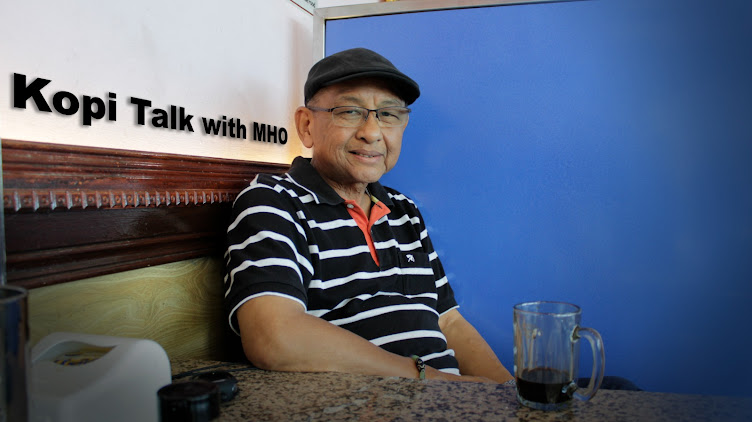
His Majesty’s Ilal Hijrah 1448 titah named the algorithm as a threat to akidah. Gen Z and Gen Alpha are being formed online faster than our institutions can respond. And 2035 is not far away. #KopiTalkMHO #IlalHijrah1448 #Brunei

Analysis & Commentary
His Majesty’s Ilal Hijrah 1448 address named the threat plainly. The question now is whether Brunei’s institutions — and its families — are listening.
By Malai Hassan Othman | KopiTalk with MHO | Majlis Sambutan Ilal Hijrah 1448 | 4 Julai 2026
It was sometime in the early years of the new millennium. A friend at the coffee shop — a member of parliament, as it happened — was talking about young Bruneians and the internet, which had just arrived in most homes and was already making itself comfortable in ways nobody had quite anticipated.
He said something I have not forgotten. A Bruneian, he said, is like belacan. No matter what dish you put it in, it gives the dish its character. But if you pound it too fine, if you lose its texture entirely, it becomes something else. You can still smell it. But it has lost its form.
He was talking about identity. About what happens to a generation when the environment shaping it is no longer the home, the surau, or the school — but something borderless and ungoverned that arrives through a telephone line and carries no particular loyalty to Brunei or to Islam.
That was the era of dial-up internet and early chat rooms. There was no smartphone. No TikTok. No algorithm that knew your child better than you did.
Those were the themes I wrote about in the early years of this column, when KopiTalk first appeared in the Borneo Bulletin. The concerns were real then. But they were, in the scheme of things, early warnings — raised in a newspaper column, circulated at the coffee table, and largely absorbed into the general noise of a country moving fast into a new era.
What felt like a coffee shop concern then is now the subject of a royal address.
At the National-Level Majlis Sambutan Ilal Hijrah 1448, held on 4 July 2026 at the International Convention Centre in Berakas, His Majesty the Sultan and Yang Di-Pertuan of Negara Brunei Darussalam, Sultan Haji Hassanal Bolkiah Mu’izzaddin Waddaulah, spoke under the theme Hijrah Penyelamat Aqidah — the Hijrah as Saviour of Faith.
The choice of theme was not ceremonial. It was diagnostic.
The titah identified the rapid development of digital technology as one of the defining challenges facing Muslims in this era. The concern was specific: the digital world has created a space without borders for ideas and opinions that contradict akidah. If these are allowed to spread without check, they carry the potential to disturb religious harmony in Brunei.
His Majesty then named something that deserves more attention than it has received in the commentary that followed. He named specific practices he does not want questioned: tahlil, talqin, ziarah kubur, the celebration of Maulidurrasul. These are practices of the Ahli Sunnah Wal Jama’ah tradition. They have, in recent years, come under quiet pressure from stricter interpretations, including Salafi-influenced views, that travel freely through YouTube channels and WhatsApp forwards produced far beyond Brunei’s borders.
This is not a theological dispute. It is a question of sovereignty — over the religious formation of an entire generation.
The titah called for a holistic approach to developing a generation that is not only academically excellent but possesses sound akidah and noble character. It named the symptoms of what is already going wrong: children who do not obey their parents, who reject advice; bullying and breach of discipline in schools. These are not new problems. But they are accelerating, and the titah is pointing at the accelerant.
Gen Z and Gen Alpha are the first generations for whom the digital environment is not merely an addition to life. It is the environment itself. Their religious formation is happening — whether institutions acknowledge it or not — through content produced by people who have no stake in Brunei’s future and no knowledge of its tradition.
These are the young people who will be in their twenties and thirties when Wawasan Brunei 2035 arrives. They will staff the civil service, run businesses, raise families, and shape the next generation. What they believe, how they reason morally, and whether they feel grounded in who they are as Bruneian Muslims are being shaped now, largely outside the institutions built to do that shaping.
The Hijrah, the titah reminds us, was not simply a change of location. It was the deliberate construction of a new environment in which faith could take root and grow. The Prophet migrated not to escape difficulty but to build something — a community, a moral order, a civilisation — in conditions where it was possible to do so.
That is the instruction embedded in the theme. Brunei cannot and should not wall itself off from the digital world. But it must build within it and alongside it — in families, schools, mosques, and communities — an environment strong enough that its children know who they are before the algorithm decides for them.
The titah directed this responsibility at everyone: government agencies, educational institutions, mosques, scholars, youth, and all levels of society. That breadth is deliberate. The digital threat to akidah does not enter through one door. It enters through every connected device in every home. The response cannot come from one ministry. It must come from the whole fabric of Bruneian life.
His Majesty expressed hope that the spirit of Ilal Hijrah would be genuinely lived — not observed as an occasion but internalised as a commitment to the strengthening of Ahli Sunnah Wal Jama’ah through balanced human development. That is a specific and demanding aspiration. It is not a wish. It is a standard.
My friend at the coffee shop was not wrong about the belacan. But he was describing a slow process.
What we are living through now is not slow.
The algorithm is fast, relentless, and indifferent to everything except engagement. Brunei’s children are growing up inside it. The families, the schools, the mosques, and the institutions that are supposed to give them roots before it gives them everything else — they are running out of time to decide whether they are paying attention.
The Hijrah was an act of urgency.
So is this.
Malai Hassan Othman is a veteran journalist and political analyst. KopiTalk with MHO is published on Substack.

.jpeg)
No comments:
Post a Comment