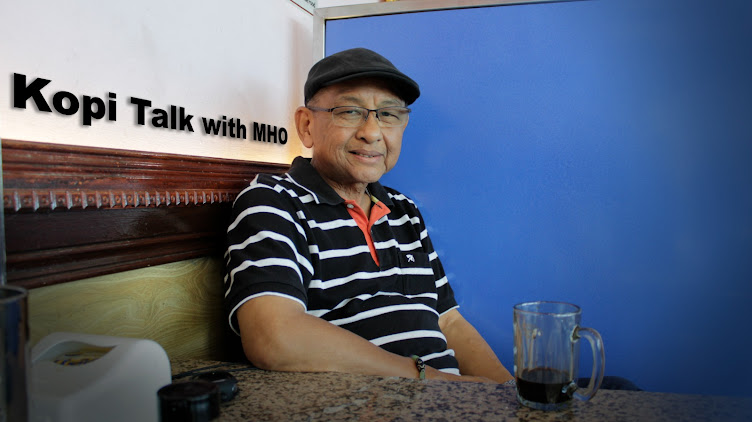

KOPITALK WITH MHO
By Malai Hassan Othman · 21 May 2026 · Bandar Seri Begawan
The rejection came quietly.
A WhatsApp message, four lines, received at 4:12 on a Wednesday afternoon. A bookstore had decided, after careful consideration, not to carry a particular book. The title was political, the message explained. It did not fit the store's current product selection. Thank you for your understanding. Best wishes with the publication.
That was all.
Polite. Almost apologetic in tone. The door closed without a sound.
But something about that message stayed with me. Not the disappointment of a book not reaching a shelf. That happens. What stayed was the word used to explain it.
Political.
I have been writing about Brunei for more than forty years. I have covered government, economy, social affairs, faith, and the quiet anxieties of everyday life. And in all that time, one thing has remained stubbornly consistent: the fastest way to end a conversation in Brunei is to attach the word political to it.
It works like a full stop.
Discussion over. Window closed. Move along.
The book in question was not about elections. It was not campaigning for any party, and it was not calling for the overthrow of anything. From what I understand, it explored governance, participation, procurement, food security, youth engagement, and the honest question of whether Brunei is executing well enough on its own ambitions.
The kind of content one might find in a serious policy journal.
The kind of conversation that takes place in boardrooms, ministries, universities and, yes, in kopitiams across this country, every single day.
But it carried a label.
Political.
And that was enough.
Here is what I want to ask, simply and without malice: when did thinking seriously about our country become political?
There is a Malay concept that I find far more accurate for this kind of writing.
Muhasabah.
Self-reflection. The honest act of looking at where we are, what we are doing, and whether we are doing it well enough.
Muhasabah is not an act of opposition. It is an act of care. A Muslim who performs muhasabah at the end of the day is not attacking himself. He is trying to be better tomorrow. The same principle, applied honestly, holds for a nation.
"When a columnist writes about why government procurement takes too long, that is not politics. These are questions any responsible citizen, any thoughtful leader, any good manager should be asking. They are questions of national muhasabah."
When a columnist writes about why government procurement takes too long, that is not politics. When a researcher asks whether Brunei's youth are being given meaningful opportunities to contribute, that is not politics. When a policy thinker examines why Wawasan 2035 targets are not moving fast enough, that is certainly not politics.
These are questions any responsible citizen, any thoughtful leader, any good manager should be asking.
They are questions of national muhasabah.
The trouble is that we have allowed the word political to do the work that discomfort wants done. If a discussion makes us uneasy — if it asks us to examine systems we built, decisions we made, or habits we have settled into — it is easier to label it political and step away than to sit with the discomfort and think it through.
That habit, I would argue, is far more dangerous to Brunei's future than any book about governance.
Think of it this way.
If an engineer cannot discuss why a bridge is cracking, the bridge does not get fixed. If a doctor cannot discuss why a patient is not recovering, the patient does not get better. If a nation cannot discuss why its institutions are underperforming, its institutions do not improve.
Silence does not solve problems.
Silence only makes them harder to see until they are too large to ignore.
There is an irony here worth naming carefully. In many countries, including some in our own region, bookstores and public libraries often carry shelves of books on governance reform, economic policy, institutional failure, leadership mistakes, national renewal and public accountability. These societies are not perfect. They have their own red lines, pressures and sensitivities. But they have generally learned to treat serious policy discussion not as a threat in itself, but as part of the wider process of national learning.
That is the distinction we need to understand.
Discussion is not the enemy of development.
Discussion is part of development.
Wawasan 2035 is an ambitious vision. It speaks of a dynamic and sustainable economy, a skilled and educated people, and a high quality of life. But visions do not deliver themselves. They require honest conversations about what is working, what is not, and what genuinely needs to change.
They require intellectual courage — the willingness to ask difficult questions without needing to create difficult enemies.
They require citizens who feel empowered to think aloud, and institutions secure enough to listen without flinching.
A bookstore that will not stock a book about governance because it might seem political is not necessarily trying to silence anyone. It may simply be making a commercial decision in an environment it understands better than most of us care to admit.
That is why I do not blame the bookstore.
What is worth examining is the environment itself — the one in which a book about participation and accountability feels like a risk worth avoiding rather than a contribution worth considering.
Perhaps the real question is not whether a book is political.
Perhaps it is a simpler one: does it help us think more clearly, act more honestly, and build something better together?
If the answer is yes, then whatever label we choose to put on it, it deserves a place in our national conversation.
A nation does not grow through silence, ceremony and slogans alone. It grows through the courage to say, clearly and without bitterness, that we can do better than this.
That is not politics.
That is love for country.
---
KopiTalk with MHO · kopitalkmho.blogspot.com

.jpeg)
No comments:
Post a Comment