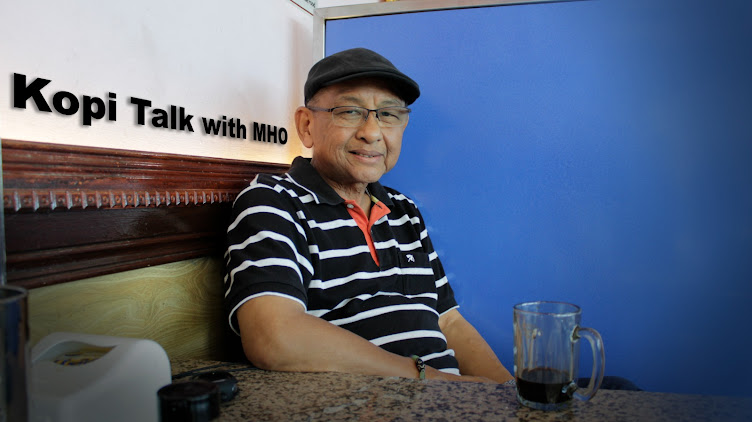
KOPITALK WITH MHO | 22nd Legislative Council Session — Closing Report
Eight Days, One Budget, One Question:
After the Answers Were Given, Who Stayed Responsible?
KopiTalk with MHO • Closing Report • 22nd Legislative Council Session • Days 1–8 | 11–19 March 2026 • Session resumes 25 March 2026

|
A young man in Belait is wondering if the industry that built his family still has a place for him. A mother is still photocopying textbooks so her son can read. Eight days. BND6.3 billion. And one question that outlasted all the answers: when the session ends — who is still responsible? |
The Promise
The session began, as it always does, with confidence. The budget was tabled. The numbers were structured. The direction was clear. There were strategies, frameworks, and priorities aligned with long-term national goals. The language was steady and assured.
It was the official story of the system: we have a plan. We know where we are going. We are managing the future. And on paper, that is true.
No one doubted the intention. No one questioned the commitment. The budget, the ministers, the members — all present, all engaged, all serious about what they were doing. That matters. It is the foundation on which everything else has to be built on.
The Friction
By Day Three, the questions began to land differently. Roads. Housing. Transport. Delays in development projects. Gaps in service delivery.
Nothing dramatic. Nothing unexpected. But something important shifted. The discussion moved from planning to delivery. It became harder to ignore a simple pattern: the plans were there. The execution was uneven.
By Day Four, that pattern had a name. Brunei does not have a planning problem. It has a delivery problem. That was not said as an accusation. It emerged as an observation — repeated across sectors, reflected in timelines, and felt in everyday experience.
And it was at this point that a reader — writing in response to the series — put something plainly that stayed with this column for the rest of the session. A nation cannot be built, they said, if its people are left to fend for themselves. The brightest young minds — the ones this country needs most — are not thinking about nation-building when they are thinking about survival. How can a generation contribute to a future they are not yet sure they belong in?
We are no longer at a stage where activity is impressive. Only outcomes are.
The Reality
By Day Five and Six, the lens widened. The discussion moved beyond internal systems into the pressures shaping them. Budget constraints. Revenue ceilings. External economic shifts. Workforce strain. Mental health signals. Barriers to doing business.
Inside the chamber, answers were structured and measured. Outside it, the experience was less orderly. A worker is managing long hours without proper protection. A family stretching its income across rising costs. A young adult carrying uncertainty into their twenties.
It raised a quiet but difficult question: are we still talking about the same reality?
There were signs of movement — reviews underway, reforms being discussed, and a growing openness from ministers about constraints within the system. These are not small developments. But they are still steps, not outcomes.
DMAO — who has written in response to this series across multiple days — named this precisely. He drew on productivity research from the Centre for Strategic and Policy Studies to make his point: productivity is not built on the presence of resources. It is built on persistence in using them. His formula was simple. Productivity equals execution multiplied by continuity. If execution starts but does not continue, productivity stagnates. If follow-up stops, outcomes disappear.
We have become very good at starting. Launching. Announcing. Responding. But productivity is not created at the point of launch. It is created at the point of sustained follow-through. That is the gap DMAO has been naming since Day Six — and it is the gap that ran through every day of this session.
The People
By Day Seven, the numbers began to take shape as people.
A family in Belait — three generations tied to a single industry — asking what comes next. A man whose grandfather worked for Shell. His father did too. Now he is being told, gently and without certainty, that the path may no longer be there in the same way. Not because he is unwilling or unqualified. But because the industry that gave his town its identity is contracting, and the industries meant to replace it have not yet arrived in his street.
Civil servants suspended for years, their families managing on half salaries while waiting for a system to reach a conclusion. Some of those cases date back to 2020. A member of the chamber named them specifically, by department and by year. The minister acknowledged the problem and promised a review of the rules that have governed suspensions since 1998. The review is welcome. But it does not give those families the years back.
Young adults seeking help for anxiety in a system already under strain. More than 13,000 people were in mental health treatment in a single year. A 17 per cent increase. The largest group affected: people in their early twenties. The same people the chamber has been discussing all week — the unemployed graduates, the skills-mismatch generation, the ones carrying the weight of a future that keeps feeling just out of reach.
The budget speaks in billions. But the people inside it are speaking in ones.
The budget speaks in billions. But the people inside it are speaking in ones.
The Gap
Day Eight closed the session with its clearest image. A mother at a photocopier.
The Ministry of Education has over BND576 million allocated for 2026/2027. There are policies, programmes, and frameworks. And yet a child with a visual impairment is still waiting for materials he can use — while his mother produces them herself, page by page, year after year, at her own cost. A member of the chamber knows this family personally. She saluted the mother. Then she asked the question that mattered most: what about the parents who cannot afford even a photocopier?
DMAO took that image and pushed it further than anyone else in this conversation. He asked whether the real problem is not just a delivery gap, but a design gap. Citizens, he argued, are still being treated as passive recipients — people the system delivers to, rather than people the system works with. But in reality, families like that mother's are already solving problems. They are already filling gaps. They are already contributing — quietly, without recognition, without support, and without any formal place in the national delivery chain.
He introduced the idea of a WAQAF model — not as a religious obligation alone, but as a civic culture. A shared photocopier in a mosque or community centre, maintained by volunteers, available to any family that needs it, sustained by collective ownership rather than individual burden. One machine. One community. One less mother standing alone.
It is a practical idea. But it points to something bigger. Until the system recognises, enables, and scales the contribution that citizens are already making — quietly, at home, at their own expense — the gap will keep reappearing in different forms.
This gap appeared in other forms across the session, too. A minister is calling an event organiser, when what is needed is a policy framework for how foreign vendors participate in Brunei's festive economy. A welfare system using 2015 data, while families live in 2026 prices. A stock exchange is planned for 2027, while savers are looking for options today. The system knows the problems. It can name them clearly. It is still working to close the distance between naming and fixing.
|
"This is a dangerously accurate piece and that's exactly why it matters. We are no longer at a stage where activity is impressive. Only outcomes are." — A reader, responding to this series |
An international reader — writing from outside Brunei — added a different dimension. He suggested that outcomes need to be valued and placed on the national balance sheet, not just counted as activities. If an investment is made, someone should be asking: What did it generate? Not just in money, but in human capability, adaptability, and resilience. What increased? What improved? Was the outcome recognised, measured, and replicated? Or did it disappear into a report that no one returned to?
The Question
Across eight days, the Legislative Council did what it is meant to do. It debated. It questioned. It answered. It recorded. Some answers were detailed. Some were candid. Some were genuinely encouraging.
But as the session drew to a close, one question — raised by DMAO in response to this series and repeated in different forms across each of his papers — remained unanswered.
After the answer is given, who is still responsible?
Who returns in six months to see if the textbook arrived? Who checks if the welfare rate changed when the KMKA was updated? Who follows up when the conversation ends, and the chamber goes quiet? Who owns the outcome — not just the announcement?
DMAO framed this as a national vital signs question. He listed four diagnostics. Continuity — does the system keep its pulse across leadership changes, or does it restart every time? Follow-through — is the pressure maintained until results actually arrive, or does it ease the moment the answer is given? Accountability — is there real ownership, or does everyone being responsible mean no one is? Execution speed — does the system respond at the pace people need, or at the pace that is comfortable?
These are not rhetorical questions. They are the difference between a session that matters and a session that was held.
His diagnosis was clear. Brunei does not have a budget problem. It does not have a policy problem. What it has is a continuity and execution discipline problem. And beneath that — a behavioural problem. Because continuity is not a structural issue. It is a discipline. And follow-through is not a procedural issue. It is a matter of character.
Brunei does not have a budget problem. It does not have a policy problem. What it has is a continuity and execution discipline problem.
The Measure
The moon was sighted on Thursday evening. Ramadan ended. The country moved into Hari Raya. The Yang Di-Pertua closed the chamber warmly, wished everyone well, and noted that when they reconvene on 25 March, the mood may be different.
He was right. The mood will be different. The questions will not.
A young man in Belait is still looking at his future and quietly recalculating it. His grandfather's industry is contracting. The new industries are still arriving. He is in between — not abandoned, but not yet held.
A civil servant is still waiting for the review that will update the rules that put him on half pay. The review was promised. It has not yet happened.
A young adult is still sitting in a mental health waiting room, managing what the economy has not resolved. The numbers are rising. The capacity is strained. The plan exists. The gap remains.
And a mother is still at the photocopier — making sure her child does not fall behind, in a system that already knows he needs help and has not yet made it easy to give.
They were all in the room across these eight days. Not as statistics. As people. Visible, specific, and impossible to reduce to a line item.
This series — KopiTalk LegCo Tracker — has tried to keep them visible. To report not just what was said, but what it meant for the people it was said about. DMAO, writing day after day alongside this series, kept asking the harder version of the same question: not whether the system cares, but whether it is designed to follow through.
Readers responded. Some from inside Brunei — business owners, young professionals, community members who recognised their own situations in what was being reported. Some from outside — people watching a small, oil-dependent nation navigate a genuinely difficult transition with seriousness and care, but sometimes without the institutional discipline to sustain what it starts.
The session will resume. The committee stage will continue. More ministries will be debated. More questions will be asked. More answers will be given.
The real measure of what those eight days were worth is not in the Hansard. It is in what happens between now and the next time the same questions are raised.
Will the textbook arrive? Will the welfare rate move? Will the young man in Belait find a path that does not require leaving everything his family built? Will the mother be able to put down the photocopier?
Those are not grand questions of national policy. They are the small questions that test whether the large answers meant anything.
Because in the end, a system is not measured by what it plans — but by what it no longer asks its people to fix on their own.
Editor's Note
This closing report concludes the KopiTalk LegCo Tracker series covering the first eight days of the 22nd Legislative Council session, 11–19 March 2026. The session was adjourned before Hari Raya Aidilfitri and is scheduled to resume on Wednesday, 25 March 2026. KopiTalk with MHO thanks all readers who wrote in, responded, and engaged with the series — particularly DMAO, whose sustained civic commentary across every day of this session added depth, rigour, and an accountability framework that no daily report can match alone. The series continues when the session resumes.
KopiTalk with MHO | Public interest. Plain language. Honest conversation.
What was said, what mattered, and what the public is still waiting for.

.jpeg)
No comments:
Post a Comment